

The Builder Mindset

Reflecting On My Habits That Outlasted the Firm
Fourteen months ago I sat on my couch with my laptop creating my first to-do list for The Schuckman Group. By the way, that to-do list is still running. I needed a system to track client work, project plans, contracts, every email. I needed a way to run payroll and pay contractors and keep my finances well organized. I needed a bookkeeper, an accountant, an attorney, and a bench of people I could call when a project needed more hands than mine. I was on LinkedIn and on my phone posting, texting and calling everyone I knew to tell them I was starting a business.

Like Any Great Relationship, It Takes Nurturing
I coached a pursuit team through eight months to win an engagement large enough that people across the firm were tracking it long before the client even sent out the RFP. I sat in the room the night before the final presentation while they rehearsed the pitch twice, tweaked their slide deck, and ran it again. Somebody ordered pizza nobody ate. Two weeks later the call came through that they had won. The partner leading the team called me with the good news before he called his own boss.

They Already Asked AI. They Need More Than That from You.
A few months ago I was doing a client satisfaction check-in for a small trusts and estates boutique, the kind of outreach a consultant does on behalf of a corporate client. I asked Angela, the CFO at a large family office, how things were going with her attorney. She paused, then told me something I have not stopped thinking about since.

Land and Expand: Win the Beginning Game First
"Land and expand" is a phrase everyone in professional services throws around. Most people think about it the wrong way.
They think it means taking a small deal at a low price now so you can push for the big one later. That's not how I think about it.
A few months into starting The Schuckman Group, a prospective client asked me to price out a full year of training and coaching for their leadership team. I proposed three months instead.
Not because I didn't want the whole year. Because I didn't want to lose it before it started.
My latest article is about why the second door only opens if you walk through the first one well.

Becoming a Rainmaker One Rep at a Time
A few months ago I was coaching a tax lawyer named Elena. Ten years into her career, graduate of a top law school, one of the best M&A specialists in her practice. The partners loved her work. Clients asked for her by name. She had just been told she was on track to become a partner within the next 2-3 years, and she asked me what else she needed to do.

Use Your Leaders More, And Use Them Well
I was coaching a pursuit team on a piece of business large enough that every serious competitor in the market wanted it. It was a name-brand client, the kind of logo that gets mentioned across a firm for years. When I raised the idea of bringing in their CEO early, in the first pursuit planning session, nobody on the team had thought it was needed. I had assumed that using your top leaders strategically to win work was obvious. The team did not.

The Pursuit Function Nobody Has Built Yet
Denise, a Chief Commercial Officer at a global consulting firm, sat down last fall with twelve proposals her firm had submitted over the prior six months. She read the executive summaries back to back. By the fourth one, her eyes started to glaze over.
Same opening move. Same value language. Same promise to be a trusted partner who understood the client's business. Professionally produced. Not one of them would have made a buyer lean forward.

The Other Firm Was Still Checking Its Math
Two accounting firms got an invitation to bid on the same engagement last year, a family business that had finally outgrown its founder's brother-in-law, who had run the books out of a home office for fifteen years. The business had grown past what one person could manage. It needed bookkeeping, tax planning, and financial statement preparation, the kind of support a company brings on once it stops being a kitchen table operation.
Both firms had some history with the owner. They had crossed paths at industry events, sat on the same nonprofit board, exchanged a few calls over the years. That history was enough to get both firms onto the short list. It was not enough to decide who would win the work, though one of the two firms believed otherwise.

Doing What’s Expected Is Not a Relationship Strategy
Dave's team served the same client for five years. They completed their work accurately and on time. They showed up to every meeting with reports and data.
They lost the account long before they even knew it was lost. The client send out an RFP, Dave's team responded, but the client had decided to move on before the RFP ever went out.
The reason had nothing to do with the work.
My latest article is about what a team gets wrong when it confuses delivery with relationship management.

Comedians End With the Punchline. A Business Meeting Shouldn't Be a Comedy Show.
There is a reason comedians save the punchline for the end. The audience came for it. The setup is part of the experience. The wait is expected.
A client meeting is not a comedy show.
Your clients showed up with something on their mind, a decision to make, a problem to solve, or a nagging question about whether the firm sitting across from them is the right one. They did not come to enjoy the buildup. They came to get to the part that matters.
This week's article starts in an orals rehearsal where everything was right except the order. What happened next is something I have seen change the outcome of more client presentations than almost anything else I coach.

They Didn't Buy the Work. They Bet on Themselves
When a professional services team loses a competitive pitch, there is often a common reaction: "the other firm bought the work," or "they'll never be able to deliver what they promised". It is a comforting explanation. It is also usually wrong.
AI is changing what it costs to deliver certain kinds of work, and the firms paying attention are pricing accordingly. They are betting on themselves, telling a confident story, and then running hard to make it real. The firms calling that reckless are the ones watching their pipeline shrink.
This week I wrote about the difference between those two firms, and which one you want to be.

Stop Asking What Keeps Them Up at Night
A senior partner I coach, started a client meeting with a question she had clearly used before.
The client answered. The presentation was relevant. Everyone left happy.
Shortly thereafter, the client put the work out to bid.
The question wasn't wrong. It just wasn't good enough. And in today's environment, good enough is exactly the gap your competitors are walking through.
Article 4 of "The Builder Mindset: Winning the War for Clients in Professional Services" is about the questions that actually work, and what happens when you finally ask it.

Growing Your Network Every Day
This is a series of weekly articles I’m releasing throughout the summer of 2026, mid-May through early September. They’re written for partners, principals, firm leaders, and BD professionals who want to grow their practices. The series shares my observations about how successful professionals (builders) approach BD, how they show up with existing clients, and how they pursue new ones.
The habits that earned you your credentials may not be the ones that grow your practice. That's what this series is about, winning the War for Clients.

A Nice Meeting Is Not a Relationship
I was brought in to help a professional services firm prepare for a competitive proposal. They had been working with this client for years. Good work, no complaints. When the engagement went out to bid, one of the partners told me they weren't worried. They had a great relationship.
They lost.
The debrief was polite. The official explanation was vague references to delivery approach, technology, and price. I had a sense there was a deeper story. There was one.
Here's the part that struck me: the incumbent team never saw it coming. And in my experience, they rarely do.
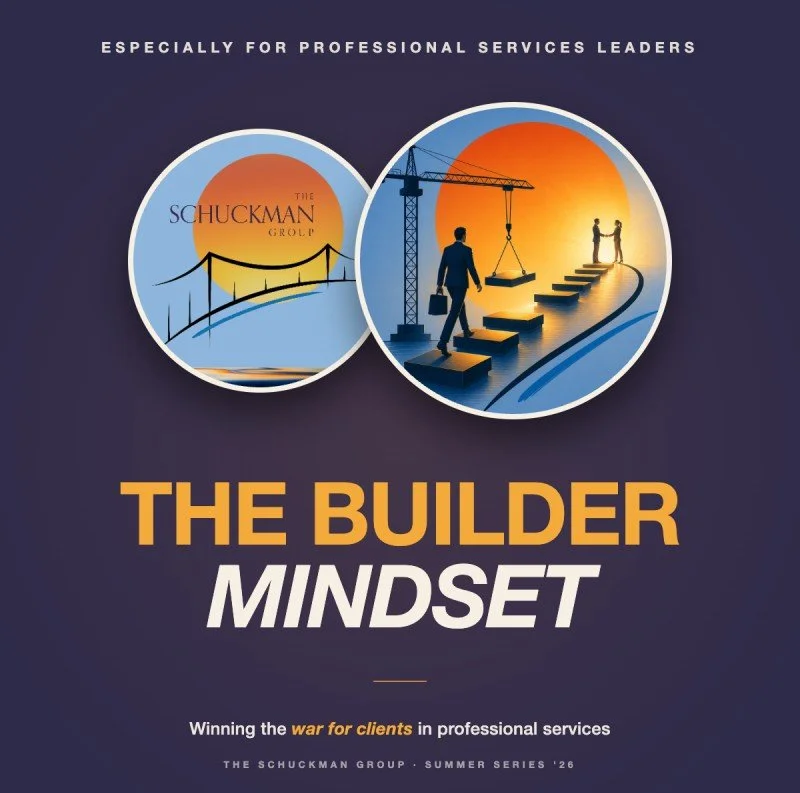
We Fought The War For Talent. Now We Have The War For Clients.
This is a series of weekly articles I’m releasing throughout the summer of 2026, mid-May through early September. They’re written for partners, principals, firm leaders, and BD professionals who want to grow their practices. The series shares my observations about how successful professionals (builders) approach BD, how they show up with existing clients, and how they pursue new ones.
The habits that earned you your credentials may not be the ones that grow your practice. That's what this series is about, winning the War for Clients.