

Mitchell’s Moments Coaching Blog
The Builder Mindset
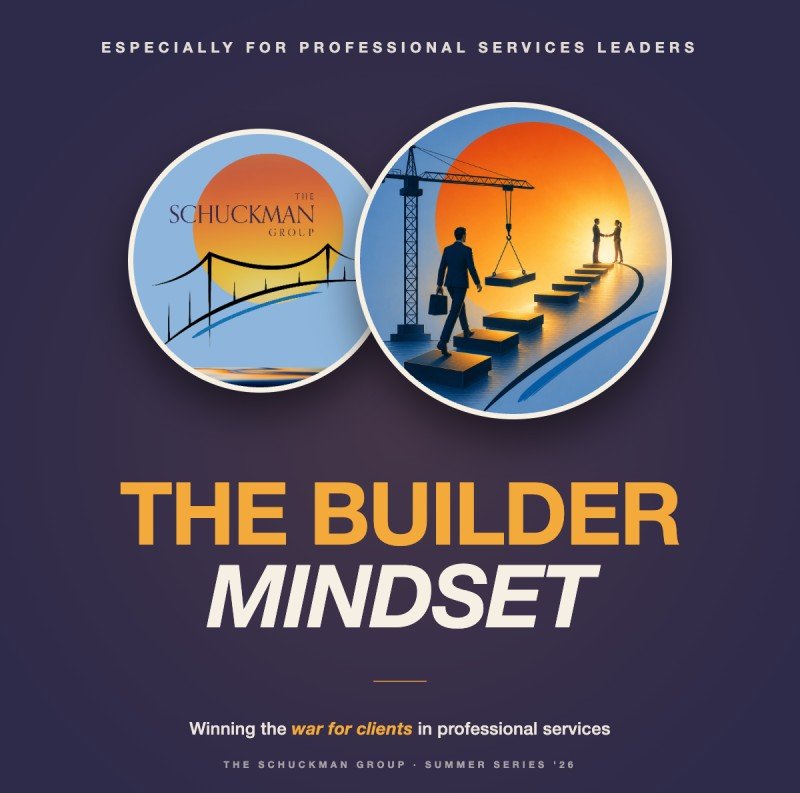
Mitchell’s content series, “The Builder Mindset: Developing Business in Professional Services,” is built around a simple premise: the war for talent hasn’t ended, but the war for clients has taken center stage. Every article is practical and specific, written for professionals who are serious about growing a practice, not just reading about it.

The Caveman, the Spear, and the Future of Your Career
I recently imagined having a conversation with a caveman who had developed a particularly effective hunting spear. Business was booming. His neighbors were exchanging meat for his spears, and he was enjoying the prehistoric equivalent of a successful entrepreneurial career.
Then someone else figured out how to make spears. Competition increased, prices fell, and the animals were becoming harder to find. My caveman was understandably frustrated.
“I invented something that was supposed to make life easier,” he complained. “Now I've got more problems than I started with.”
“Perhaps you need to evolve your business,” I suggested.
“Into what? I've heard plumbing is a good career, but nobody's invented pipes yet.”

Who Decides What You Do With the Time AI Gives Back?
I was a young tax associate the first time I worked a foreign tax credit calculation. I prepared it. A manager reviewed it and sent it back with just about everything wrong that could be wrong. I fixed it and got something else wrong on the next pass.
That went on for months.
Eventually the calculation stopped being the point. I understood why the numbers worked the way they did well enough to sit with a client and explain how their circumstances were affecting the credit, and what they could do differently to plan for a better result the next year. None of that came from a manual. It came from doing it wrong enough times, on my own time, until it finally stuck with me.

The Retirement Panic Nobody Admits To
Six months before I retired, I was at a holiday party, talking with the spouse of one of my partners. She is a senior executive, and someone I admire a great deal. She asked what I was going to do next.
I blurted out that I was going to open my own executive coaching and business development consulting firm. I hadn't planned to say it. I had barely thought it through. She said, "Oh my God, that's amazing. I would totally hire you, and I'd refer you to all my friends and clients."
Her reaction is what made it real for me. What she could not have known was what the six months before that party had been like.

I Really Like Him. I Just Can't Tell You What He's Done For Me.
Vincent sat across from me a few months ago. He runs a business unit, and the leadership team above him had set a twenty percent growth target for his group next year. He had lost four strong people in the six months before that, and he could not make sense of it. He is well liked. His team would tell you he is a good man to work for, patient, generous with his time, never the one to embarrass someone in a meeting. And his part of the business was losing ground.

Great Stories Pull People Toward You
Great stories don't just connect people. They pull people toward you.
I help teams figure out which story to tell, who needs to hear it, and how to tell it so the people across the table feel something. That is what wins competitive pitches: the right story, told to the right person.
This week's article is about why "become a better storyteller" is the wrong advice. The better advice is "pay attention to your experiences, pay attention to your audience, and share experiences that will resonate".

What Do I Tell My Kids?
The accounting major who worried he had no future called his dad. His dad called me.
I did not have a perfect answer. But I had a perspective, and it is not the one many parents are reaching for right now. The question being asked, what should my kid study, is probably the wrong one.
What actually holds its value through disruption is not a major. It is a certain kind of person. My latest article is about what I told that young accounting major.

When Leaders Don’t Need More Opinions. They Need a Trusted Sounding Board
A partner I coach, I’ll call him Richard, runs a tax compliance practice at a mid-sized accounting firm. He oversees close to 100 professionals. His practice generates significant revenue, and his firm depends on it. He also knows that the business he is running today looks nothing like the business he will need to run in five years. Probably sooner.

Can you Measure the Benefit of Coaching?
A client I coached over a year ago, let's call her Janet, sent me a message a few weeks ago that I wasn't expecting. Janet's client had come into a meeting upset about her team's analysis. The numbers were right, the conclusions were sound, the issues were cosmetic. Formatting and decimal points that changed nothing. Janet's instinct was to say exactly that.

The Hardest Thing a High Performer Can Do
A few weeks ago, I wrote about a sentence a coaching client said that stayed with me. "I now have confidence in my future, whatever my future is."
I've been thinking about that sentence ever since. Not only because it was beautiful to hear, but because another conversation widened my thinking and built on the power of that idea.

Take Up AI Like a Hobby. Your Career Will Thank You.
A few months ago I gave a presentation at PwC New York. One of the things I said was that every professional services person in the room should make AI a personal hobby. Something you pick up on your own, out of curiosity, with no one grading you.
I expected a polite nod and for everyone to move on. What I got instead were several people pulling me aside to say that framing had genuinely resonated. That surprised me. I assumed most everyone was already playing around with it. I overestimated. Many people approach AI cautiously, waiting to feel less intimidated before they start. That's exactly backwards.

The Two Sentences I Loved Hearing
I was in a coaching conversation recently with someone I have been working with for a while, let’s call her Margaret. Margaret is pursuing a higher leadership role, and much of our work has focused on how she positions herself with decision makers and in the marketplace.
During the conversation she said two things that stayed with me. At one point she said, “I now have confidence in my future, whatever my future is.” A few minutes later she added, “I feel more aligned with who I am.”

Becoming a Better Competitor After 60
Over the past few months, people have asked me the same question.
“Are you enjoying this?”
What they mean is straightforward. After a long career at PwC, can it actually be enjoyable to build a coaching and consulting practice from the ground up? They also mean it must feel strange to walk into rooms now without the PwC brand or the “partner” title attached to my name.

The Day the Clock Starts: Leadership After a Private Equity Deal Closes
In medium to large PE-backed companies, the deal closes and the clock starts. The financial model is explicit. EBITDA expansion is modeled. The exit horizon is understood. The board cadence accelerates. Leadership is now measured through capital.

From Responding to Relating: How Client Relationships Truly Deepen
I was sitting in a recurring client status meeting a few months into a long standing engagement. The work was solid, the team was responsive, and the relationship appeared steady. Midway through the meeting, the client asked for an accelerated timeline on a deliverable, and everyone immediately shifted into execution mode.

Beating Imposter Syndrome: Lessons from an 18-Year-Old Hockey Player
When the Islanders drafted Matthew Schaefer first overall and effectively handed the future to an 18-year-old defenseman this past year, I paid attention.
What I did not expect was that watching him would make me think about imposter syndrome in the workplace.

Did Einstein Get Simplicity Wrong, or Did We Take Him Too Literally?
There is a quote attributed to Albert Einstein that shows up often in leadership and business conversations: “If you can’t explain it simply, you don’t understand it well enough.” I’ve always loved this quote and I use it regularly. Clear thinking usually does lead to clearer explanations. But after years of watching how communication actually plays out in executive rooms, I’ve come to think we’ve taken it too literally because it stops short of what really matters in leadership settings.

The Leadership Need That Usually Comes Second: Better Storytelling
Spend five minutes in a leadership meeting today and you will hear some version of the same concern.
How can we adopt AI faster? What can we do to get a better return on our AI investment? What new AI-tools will transform our business?
That all makes sense. AI has changed how work gets done. It has leveled access to information, accelerated analysis, and raised the baseline of what “good” looks like..

Investing in Humans Is Important Too
There is no shortage of conversation about AI investment and ROI, but far less attention is paid to how people feel underinvested in. I’ve recently seen how powerful it is when that imbalance is addressed.

“I’ll Never Get That Time Back”: Avoiding Aimless Meetings
I sit in a lot of meetings. Client meetings. Leadership meetings. Team meetings. Planning meetings. Some in person, many virtual. And within the first five minutes, I usually know how it’s going to go.
The good ones feel prepared and thoughtful. The bad ones feel thrown together and disorganized. Too many people. Too much information to cover. No clear sense of why everyone is there. The clock starts running and somehow nothing is really accomplished, except a vague agreement to “circle back.”

When Leaders Stop Learning: The Quiet Danger No One Wants to Admit
A few days ago, Dr. Jennifer Byrnes and I delivered the first session of The Whole Leader Program. The program intentionally blends two complementary perspectives. I bring decades of experience leading businesses, driving growth, building client relationships, and operating under pressure. Jennifer brings deep clinical psychology expertise, along with a clear understanding of behavioral science and mental wellness.
That combination brings business reality and human reality together.
The Builder Mindset
Mitchell’s content series, “The Builder Mindset: Developing Business in Professional Services,” is built around a simple premise: the war for talent hasn’t ended, but the war for clients has taken center stage. Every article is practical and specific, written for professionals who are serious about growing a practice, not just reading about it.